
Photonic Thermal voltage Converter System
Patent Pending: U.S. Application No. 64/187,908
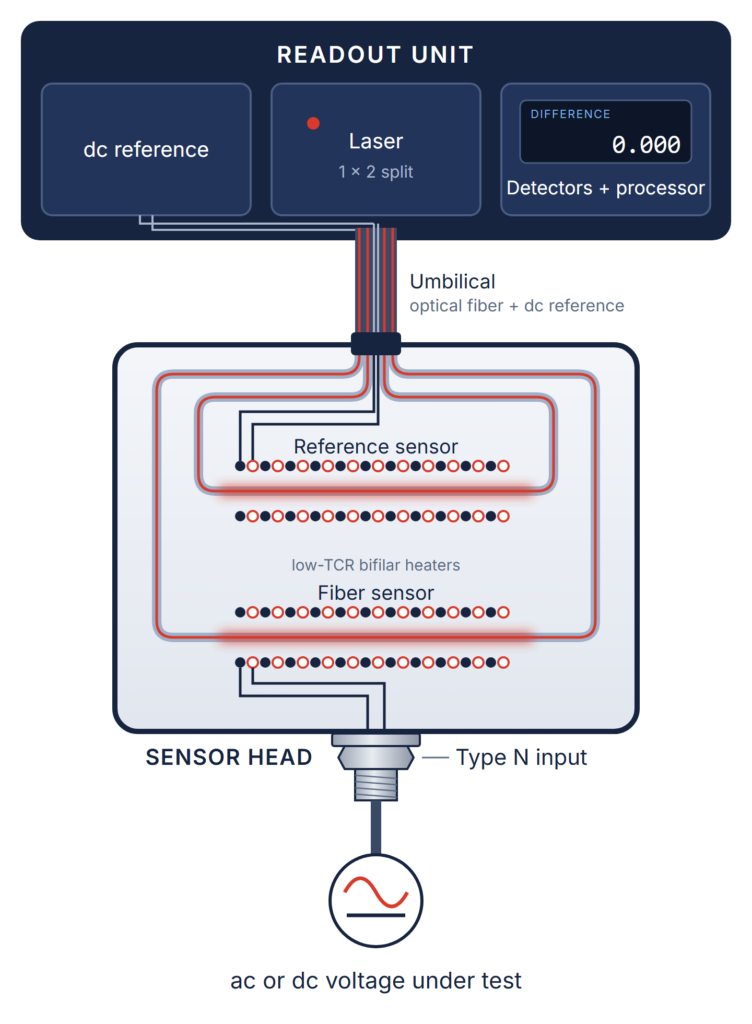
An optical readout replaces the electrical connection between the source under test and the measuring instrument, removing leakage-current paths and ground loops. Fiber sensors in a thermally matched head are read with laser light, resolving ac-dc differences below 0.1 µV/V with about one second averaging. The sensor head has a Type-N input and fits existing ac-dc transfer setups with the addition of the readout unit.
PTVCs are under development for:
- 2 mV to 1000 V, 10 Hz to 1 MHz
- 0.5 V to 3 V, 10 Hz to 100 MHz
- 50 Ω input, 0 dBm to +20 dBm, 10 Hz to 2 GHz
AC-dc Difference Step Kit – in-situ admittance correction kit
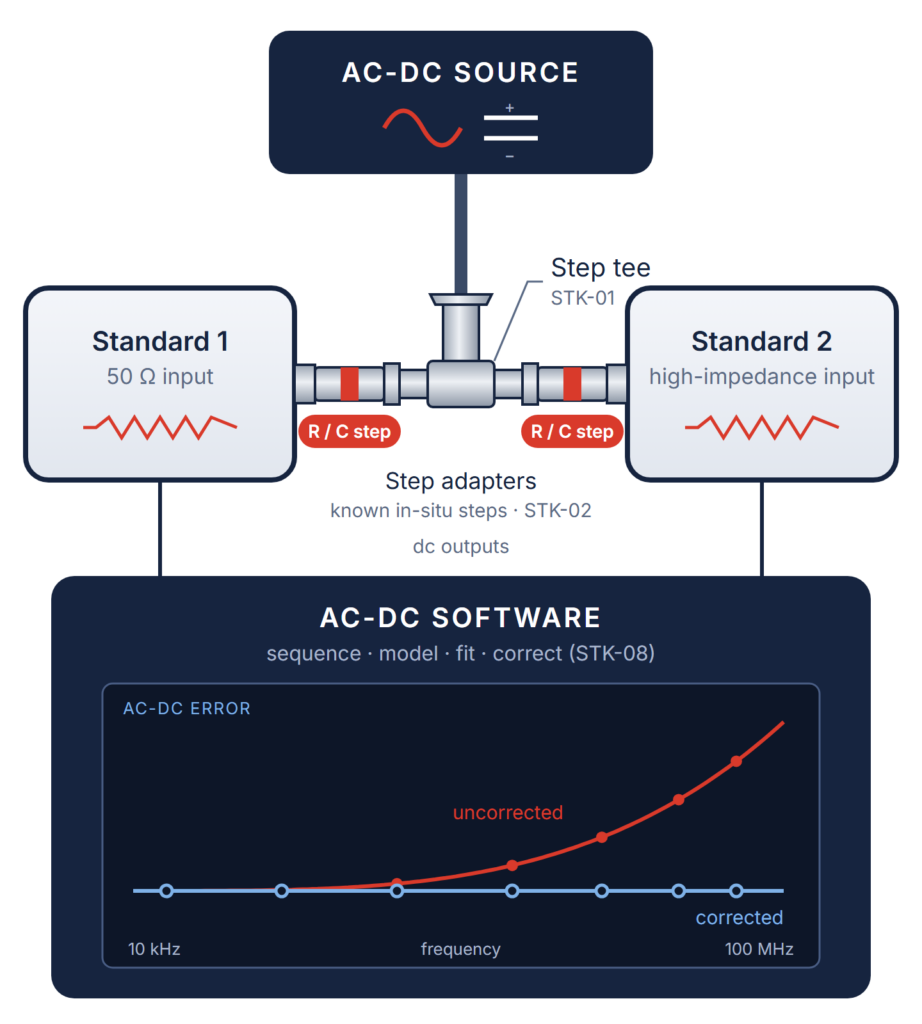
Ac-dc difference measurements assume that the standards being compared have similar input admittances. When they differ, as when a 50 Ω standard is compared with a high-impedance one, the resulting error is usually not measured. Labs either avoid the comparison or widen their uncertainties to cover it.
Cular Technologies has developed a semi-automated kit and procedure that measures this error in situ and corrects for it. Labs can then compare dissimilar standards directly, with a measured correction in place of an estimated allowance, which lowers the stated uncertainty.
The kit supports voltage scaling and comparisons between 50 Ω and high-input-impedance standards. Each kit includes:
- STK-01: Step tee
- STK-02: Step adapter pair
- STK-03: TA-50
- STK-04: Cartridge set
- STK-05: SNS1k pair
- STK-06: Emulators
- STK-08: ACDC-SW
- STK-09: Case, SMA/N torque wrenches, cables, ferrites
- AC-DC Software: model, fit, planner, sequencers, simulators
- Full documentation
AC-dc Difference Measurement Software
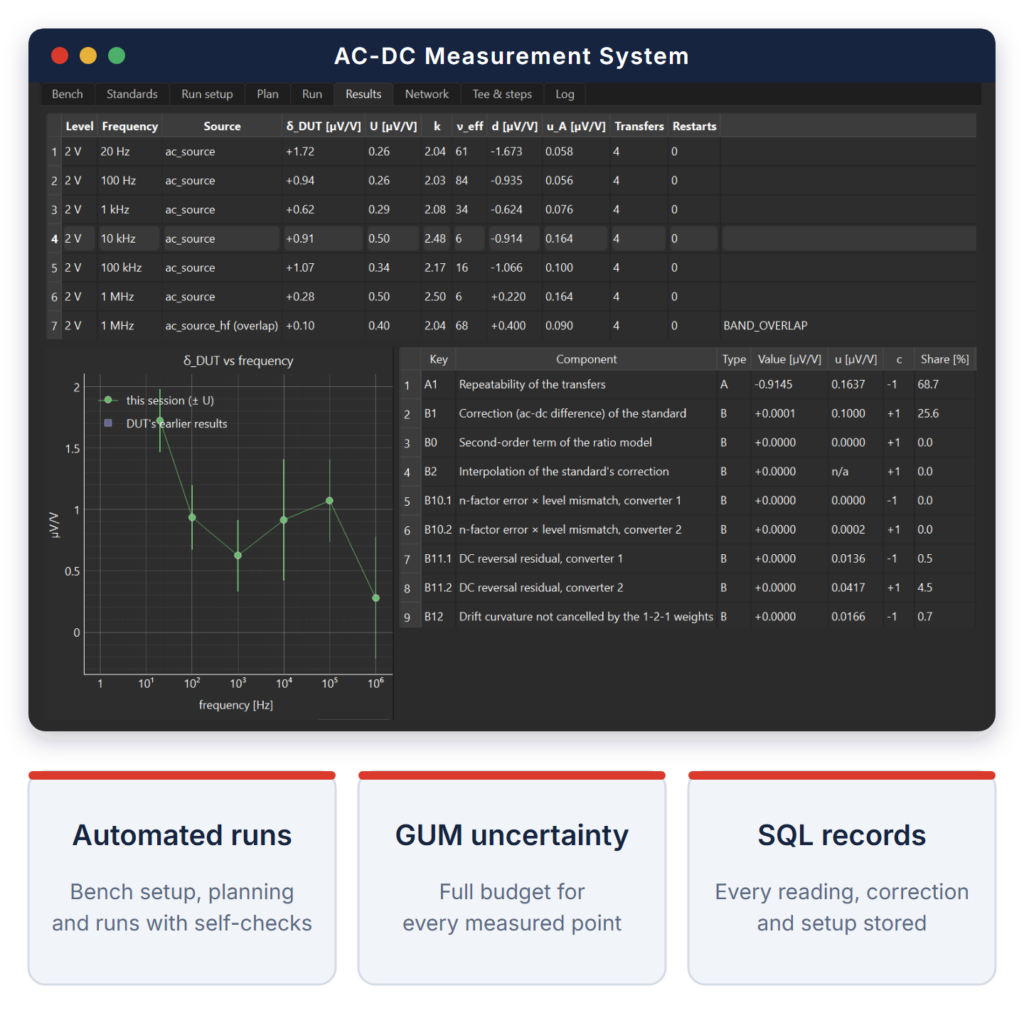
Ac-dc difference measurement software designed to support ISO/IEC 17025 accreditation, with complete, traceable records of every measurement. Features include:
- Automatic storage of all measurement data, calculations, corrections and bench setup in an SQL database
- One database per system, or one shared database across multiple measurement systems
- Data analysis and calibration certificate generation
- Support for commonly used instruments, with new instruments easy to add
- Management of standards and their corrections
- Automatic correction for input-impedance mismatch between standards (see the ac-dc difference step kit)
- Customizable to your laboratory’s procedures